
iBWS: Intelligent Building Water Systems
Building water systems, the plumbing inside hospitals, hotels, schools, and homes, are linked to 8,000–18,000 Legionella-related hospitalizations annually in the U.S. and remain the least-monitored part of drinking water infrastructure. The phenomena that drive that risk are hard to observe directly.
iBWS is how I try to see them, understand them, and act on them.
| Question | Tools | |
|---|---|---|
| Seeing | What is the water doing right now? | Sensors, building information models, data |
| Understanding | Why is it doing that? | Physics-based hydraulic, transient, and thermal models; machine learning; physics-informed learning |
| Acting | What should the building do next? | Digital twins, multi-objective optimization, AI agents |
Why this computation is necessary
The phenomena are too coupled to observe directly, too slow to simulate in real time, and too consequential to automate blindly.
- High-performance computing — the physics are coupled and the operating space is enormous. A single building spans thousands of combinations of demand, temperature, occupancy, and season. That space has to be computed thoroughly, not sampled by hand.
- Surrogate models — a coupled physics run takes minutes to hours, while optimization and real-time control need thousands to millions of evaluations. Surrogates trained on HPC results answer in milliseconds while carrying the physics behind them. HPC buys accuracy; surrogates buy speed.
- Agent-based orchestration — a real decision, such as flushing a riser or lowering a setpoint, draws on several models, live sensor data, plumbing codes, and competing objectives at once, continuously. An agent coordinates those tools and explains its reasoning to the engineer responsible for the building.
Six Components
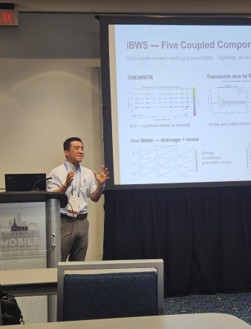
1 · BIM2WNTR — Automated Model Generation
Converts Building Information Models (BIM) to WNTR-ready hydraulic simulation networks automatically. Achieves R²>0.99 accuracy in under 10 seconds.
2 · Pump Scheduling Optimization
Multi-objective pump scheduling using NSGA-II and 54,000 HPC simulations. Achieves 45.6% energy savings relative to conventional always-on scheduling.
3 · Thermal Risk Modeling — Legionella Prevention
Physics-based thermal simulation identifying zones in the 25–45°C growth range, triggering automated flushing protocols before outbreak conditions develop.
4 · Hydraulic Transient Analysis
Pressure surge quantification across 96 building scenarios using TSNet. Identifies transient-induced pipe failure risks and informs protective control strategies.
5 · One Water Simulation
Coupled potable-drainage simulation enabling simultaneous modeling of water supply, greywater recycling, and drainage systems.
6 · iBWSS — Water Sustainability Optimization
Multi-objective optimization of rainwater harvesting, greywater recycling, and solar-assisted water heating. Achieves up to 62% water self-sufficiency across 12 U.S. cities.
Three Levels of Autonomous Control
What a building delivers goes directly into people’s bodies, so autonomy here means something narrower than “no people involved.” Engineers set the operating envelope, define what the system may do on its own, and review what it did. Within that envelope, routine actions run unattended; anything outside it returns to a person. Every automated action must be bounded, explainable, and reversible.
Technology Stack
- Simulation engines: WNTR, PySWMM, TSNet, custom thermal models
- Optimization: NSGA-II, multi-objective Pareto optimization
- AI orchestration: LLM agent frameworks, physics-informed neural surrogates
- Data integration: BIM2WNTR automated pipeline
- Computing: HPC-enabled simulation (NAIRR/ACCESS aligned)
Research Roadmap
| Phase | Timeline | Milestone |
|---|---|---|
| Component validation | 2002–2025 | Six validated physics models |
| Agent architecture | 2025–2026 | Autonomous orchestration proof-of-concept |
| Field validation | 2026–2028 | Pilot deployment in real buildings |
| Generalized platform | 2028–2030 | Multi-building scalable product |
| Full autonomy | 2030–2035 | Level 3 autonomous control |
Publications
Selected iBWS-related publications are listed on the Publications page. Key venues include ASCE Journal of Water Resources Planning and Management, AWWA Water Science, and ASCE/ASEE conference proceedings.
Collaboration & Contact
I welcome collaboration with researchers, building owners, utilities, and industry partners interested in intelligent building water systems.
Email: juneseok.lee@manhattan.edu
Google Scholar: View iBWS-related publications
iBWS builds on building water systems research since 2002.